
Mahr: what it is, who decides, and what it is not
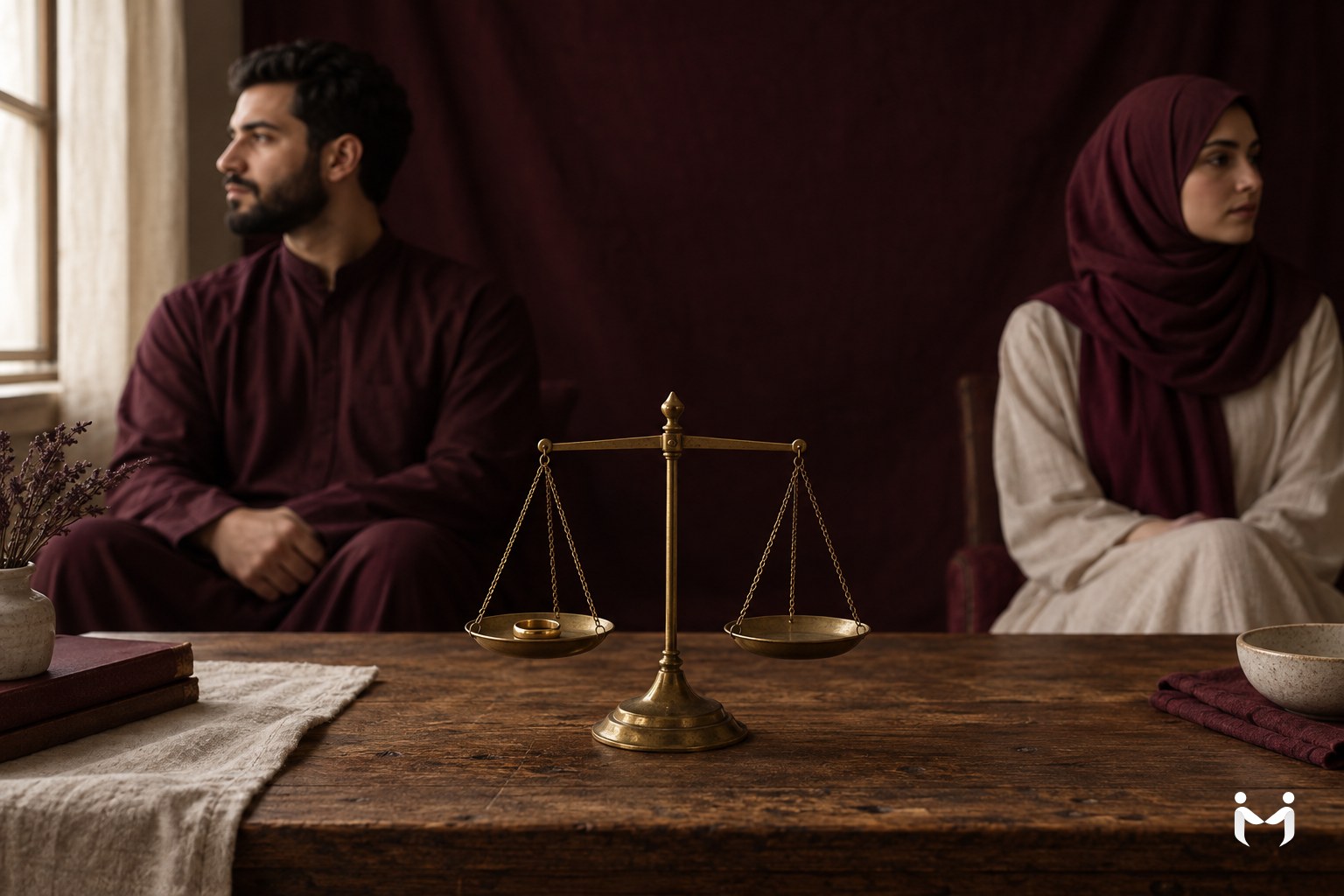
Mahr is the gift a husband owes his wife as part of the marriage itself. It is hers, not her family's. Most of what makes mahr painful in practice — inflation, bargaining, shame — comes from treating it as something it is not.
وَءَاتُوا۟ ٱلنِّسَآءَ صَدُقَـٰتِهِنَّ نِحْلَةً ۚ
“And give the women their bridal gifts graciously…”
Surah an-Nisa 4:4, opening phrase. Uthmani text retrieved from quran.com and checked character by character.
What mahr actually is
Three things, each of which gets forgotten somewhere:
- It is her property. The Qur'anic word in 4:4 is saduqat, given nihlatan — graciously, as an obligation owed to the bride herself. Not to her father, not to the household, not a contribution to the wedding.
- It is a condition of the contract, not a price. The nikah specifies it, and she is entitled to it however the marriage later goes. It is the groom's seriousness made concrete.
- It is agreed, not imposed. The amount is whatever the two of them settle on — which is where the next section matters.
How much is "right"
The texts push in one consistent direction: real, and light.
A man came to the Prophet ﷺ wanting to marry and had nothing to give. He was told: “Go and search for something, even if it be an iron ring.” He could not find even that, and was married in exchange for teaching his wife what he knew of the Qur'an.
Sahih al-Bukhari 5087, narrated by Sahl ibn Sa'd. The same narration appears at Bukhari 5121 and 5150.
And at the other end, the Prophet's ﷺ own practice:
Abu Salama asked Aisha: what was the mahr of the Messenger of Allah ﷺ? She said: twelve uqiyas and one nash — and explained that this comes to five hundred dirhams. “That was the dower given by the Messenger of Allah ﷺ to his wives.”
Sahih Muslim 1426.
Between an iron ring and five hundred dirhams sits the whole sunnah range: an amount that is real enough to mean something and light enough that marriage stays easy. Scholars across the schools recommend modesty in mahr; several famous narrations praise the lightest dowers as the most blessed. What the texts do not support is a mahr set to impress the guests, or one inflated to the point that young men cannot marry at all — which is precisely the situation in several countries we have written about elsewhere.
Mahr is not dowry — they point in opposite directions
| Mahr | Dowry (jahez) | |
|---|---|---|
| Who pays | The groom | The bride's family |
| Who receives | The bride, personally | The groom or his household |
| Status in Islam | Obligatory, Qur'anic | No basis as a demand; a gift at most |
| In practice | Often squeezed or waived under pressure | Often demanded, and lethal at scale |
The confusion between the two is not harmless. Dowry demanded from the bride's family is custom wearing religious clothes, and in South Asia it kills: India's crime bureau recorded over six thousand dowry deaths in a single year. Mahr is the opposite arrangement — protection flowing toward the bride — and calling jahez "part of our religion" reverses the direction Islam set.
Agreeing it without a fight
- Name it early. The amount belongs in the first serious family conversation, not the week of the nikah when nobody can walk away.
- It is her conversation. Fathers negotiate on her behalf by custom, but the right belongs to the bride, and her view of a reasonable amount is the one that matters.
- Deferred mahr is real mahr. Splitting into prompt and deferred portions is valid across the schools — but deferred means owed, not imaginary. Write it in the contract; it is a debt on the husband.
- Put it in writing everywhere it counts. In countries where the nikah is not automatically recognised in law, the mahr clause may only be enforceable if the civil paperwork exists too.
Where Misaq fits
Misaq exists because the machinery around Muslim marriage — rishta pressure, jahez demands, mahr inflation — has made a simple covenant expensive and slow. The app is built to put the actual parties and their families in one honest process: wali registered before matching, every member verified, one match at a time, free until a real connection happens. It has not launched yet; the waitlist opens first.
Join the communityHow nikah works, step by step
Sources
- Qur'an 4:4, Uthmani text and Saheeh International translation via the quran.com API, compared programmatically.
- Sahih al-Bukhari 5087 (Sahl ibn Sa'd), cross-checked against Bukhari 5121 and 5150.
- Sahih Muslim 1426 (Aisha, via Abu Salama) — the Prophet's ﷺ mahr of five hundred dirhams.
- National Crime Records Bureau, India — Crime in India 2023, dowry deaths.
General information, not a fatwa. The schools differ on details of minimum amounts and deferral; where it matters to your contract, ask a scholar who knows your school and your jurisdiction.
Common questions
How much mahr is sunnah?
The texts point to a range rather than a number: the Prophet ﷺ approved a marriage where the groom could not find even an iron ring and gave teaching of the Qur'an instead (Bukhari 5087), while his own mahr to his wives was five hundred dirhams (Muslim 1426). Real and light is the consistent direction.
Who does the mahr belong to?
The bride, personally. Qur'an 4:4 commands that women be given their bridal gift graciously — it is not owed to her father or family, and spending it is her right alone.
Is mahr the same as dowry?
No — they flow in opposite directions. Mahr is paid by the groom to the bride and is obligatory. Dowry (jahez) is extracted from the bride's family and has no basis in Islam as a demand.
Can mahr be deferred?
Yes, wholly or in part, and this is accepted across the schools. A deferred portion is a real debt owed by the husband — it should be written into the contract, not left as an understanding.
What is a reasonable mahr amount today?
Whatever the bride and groom genuinely agree, set early and without pressure. Many communities anchor on symbolic sunnah-linked amounts; what the texts discourage is a mahr sized to impress or to obstruct the marriage itself.
Related reading
- What Misaq is, in full
- Nikah and dating: the difference is structural
- The wali: what he is for, and what he is not
- How to get married in Islam, step by step
Stay with us while we build
We post the build as it happens. Follow whichever one you actually read.